






 Shared by Rev. Torli H. Krua, Founder and President Free Liberia Movement, Universal Human Rights International Email: harlankrua@gmail.com Telephone: (857) 249-9983
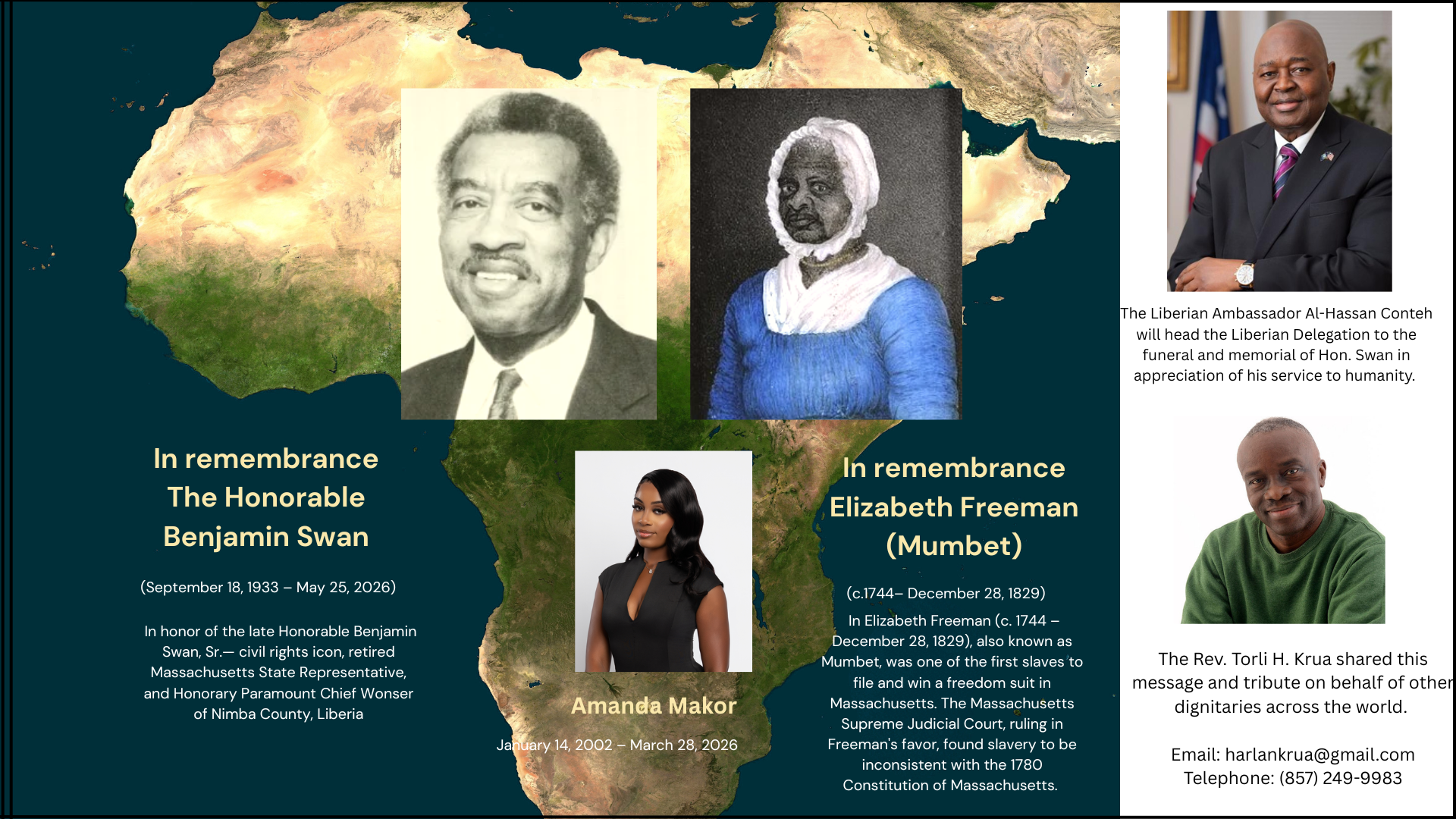
Liberian Ambassador Al-Hassan Conteh will head the Liberian Delegation to the funeral and memorial of Hon. Swan in appreciation of his service to humanity.
On behalf of members of the African diaspora, faith leaders, human rights advocates, educators, elected officials, traditional leaders, and citizens committed to liberty, equality, justice, reconciliation, and human dignity, we mourn the passing of Massachusetts State Representative Benjamin Swan, affectionately known in Liberia as Honorary Paramount Chief Wonser of Nimba County, who departed this life on May 25, 2026—African Liberation Day.
Many members of his own family, many Americans, many Liberians, and much of the international community may never fully know the extraordinary role Representative Swan played in advancing the cause of human dignity, historical truth, and reconciliation between Africa and the United States.
Today, we honor not only his life but also pledge to continue his unfinished mission. “A selfless public servant whose commitment to protecting human dignity fueled his passion to help people beyond the zip codes he was elected and paid to serve, taking him across oceans and rivers without bridges to lift little children from the dust of American colonization in Liberian villages.” Said Rev. Torli Krua.
Representative Swan stood in a long line of freedom fighters that includes an often-forgotten heroine: Elizabeth “Mumbet” Freeman, the formerly enslaved Black woman whose courage transformed American history.
In 1641, Massachusetts became the first colony in North America to legally recognize slavery. In 1670, the Body of Liberties was amended while slavery remained lawful. Yet Massachusetts would also become the birthplace of revolutionary ideas that helped inspire the American Revolution and the Declaration of Independence.
In 1780, Massachusetts adopted a Constitution declaring that “all men are born free and equal.” On August 22, 1781, Elizabeth Freeman—an illiterate enslaved Black woman born before the American Revolution—successfully invoked that constitutional promise in the landmark case of Brom and Bett v. Ashley. She won both her freedom and monetary damages, helping pave the way for the abolition of slavery in Massachusetts in 1783, decades before the Civil War and the Emancipation Proclamation.
Representative Swan understood that Elizabeth Freeman’s victory was not merely a legal triumph. It was a declaration of human dignity that challenged centuries of exclusion.
He also understood that the backlash to that victory did not end in 1781.
The promise that “all men are born free and equal” was undermined by constitutional and legal contradictions that followed, including the Three-Fifths Compromise, the Naturalization Act of 1790 restricting citizenship to “free white persons,” the Fugitive Slave Acts, the Indian Removal Act, and the Slave Trade Act of 1819.
Representative Swan courageously examined these contradictions and their consequences. In 2008, Massachusetts Democratic Representative Benjamin Swan called for U.S. citizenship rights for all Liberians as a matter of reciprocity, arguing that Liberia had long extended citizenship and welcome to African Americans and that the United States should respond with justice, dignity, and equal rights for persons born in Liberia. (allafrica.com)
Special Tribute and Remembrance
Massachusetts Constitution Day Memorial Luncheon
June 15, 2026 Massachusetts State House, Boston, Massachusetts, USA
Commemorating the 246th Anniversary of the Massachusetts Constitution of June 15, 1780.
Joint African Diaspora Memorial Service June 15, 2026
Boston, Massachusetts, USA Honoring:
- Representative Benjamin Swan
- Elizabeth Mumbet Freeman
- Amanda Tussie Makor
- 246 Years of Truth, Equality, Liberty, and Justice
Continuing the legacy
View the video: https://www.youtube.com/watch?v=imdVSObo84w&t=1s

Benjamin Swan’s Global Legacy: Why Massachusetts, Liberia, and America Must Continue the Conversation
The passing of Representative Benjamin Swan on May 25, 2026—African Liberation Day and Memorial Day in the United States—marked the loss of a civil rights veteran, legislator, educator, and freedom fighter whose influence reached far beyond Springfield and Massachusetts.
While many remember Swan for his twenty-two years in the Massachusetts House of Representatives and his participation in the Civil Rights Movement alongside Dr. Martin Luther King Jr., his international significance arose from his willingness to confront difficult truths about freedom, citizenship, race, and the unfinished work of American democracy.
In 2008, during a visit to Liberia, Swan made international headlines when he called upon the United States to grant citizenship to Liberians as reciprocity for Liberia’s longstanding policy of welcoming African Americans and their descendants. His remarks were widely reported in Liberia and throughout the Liberian diaspora and remain among the most consequential international statements of his public career.
Following his death, the Liberian Observer published “Let My People Go: African Liberator’s Last Words on African Liberation Day,” portraying Swan not merely as an American politician but as an advocate for liberty, justice, reconciliation, and human dignity whose final public message challenged both Africa and America to continue the unfinished work of freedom. The article was subsequently amplified by FrontPage Africa and other diaspora networks, extending Swan’s legacy throughout Africa and beyond.